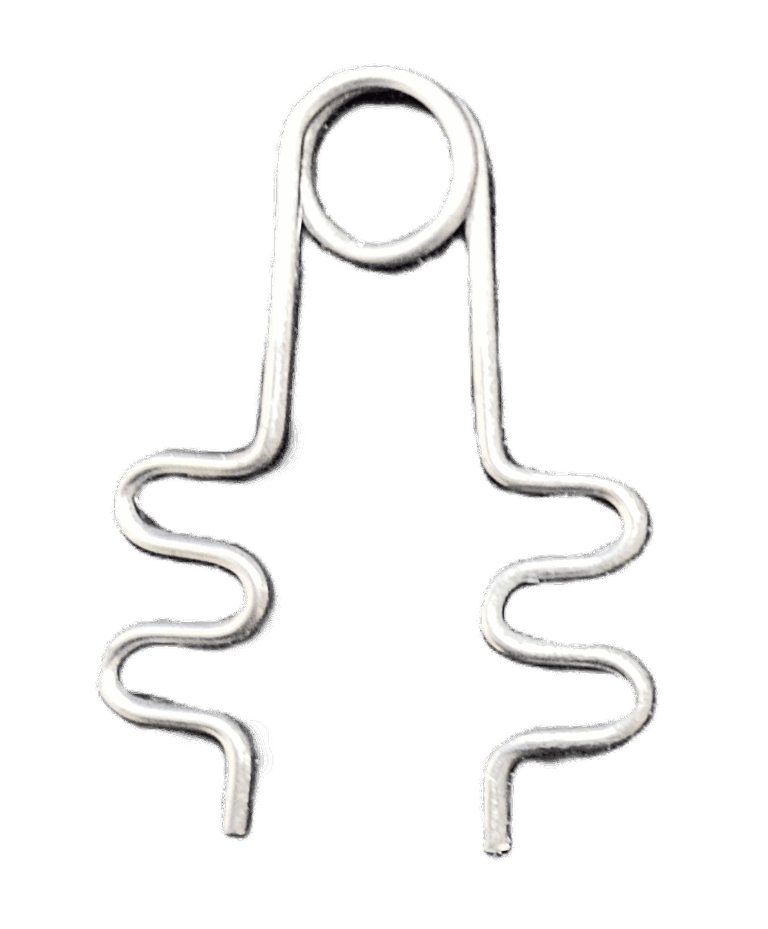
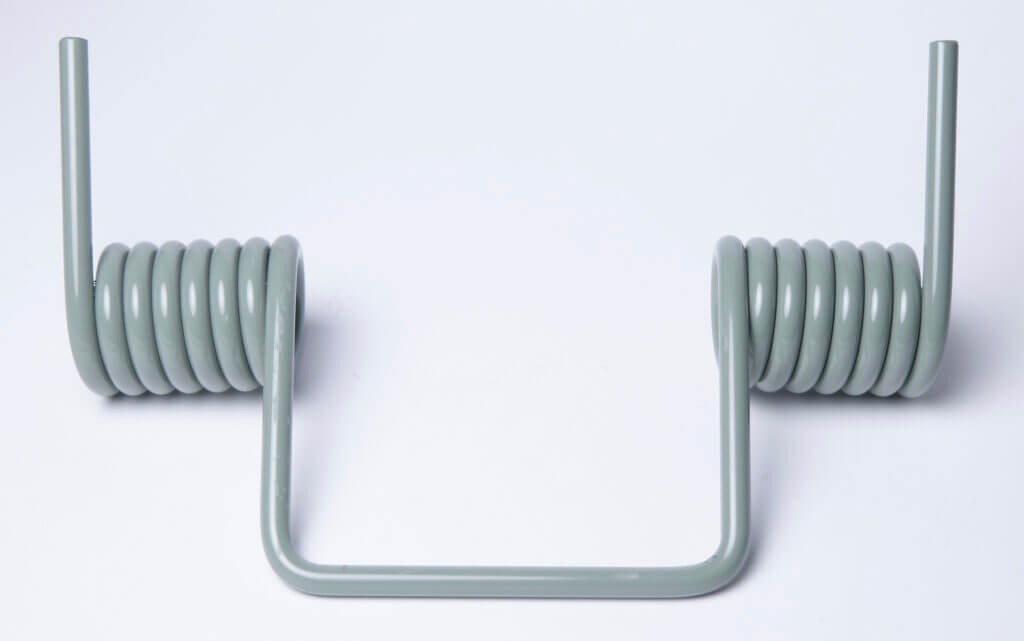
Torsion springs are a type of coil or helical spring used to apply a torque or store rotational energy and subsequently release it. The two most common types are single and double torsion springs. Diamond wire spring manufactures custom torsion and double springs for many industries large and small. Double torsion springs consist of two coils wound in opposite directions. These coils work in tandem, delivering balanced torque. We also offer stock trailer ramp springs.
Torsion springs are stressed in bending. If possible, a torsion spring should always be loaded in a direction that causes the body diameter to decrease. The residual forming stresses are favorable in this direction, but unfavorable when the spring is loaded in a direction that increases body diameter.

Unless there are unfavorable residual stresses in the end bends, Diamond Wire’s torsion springs are normally heat-treated at a low temperature to stabilize the end positions rather than fully stress-relieve them. If the direction of loading tends to increase body diameter, our torsion spring maker would typically stress-relieve the springs.
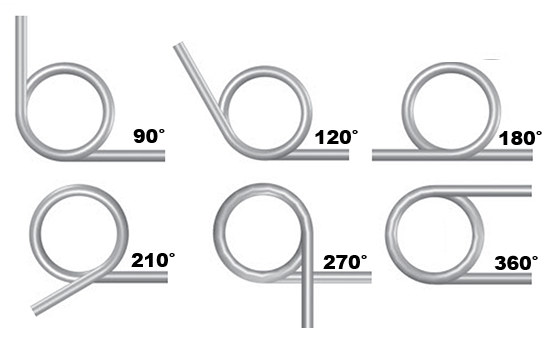
Torsion Spring Terminology
Angular Deflection: The angle of rotation as measured from the free position to the installed, intermediate or final positions.
Bridge: The second arm creating a bar connecting two torsion springs to produce a Double Torsion spring. Sometimes used to secure a spring to the equipment.
Free Angle: The angle between the arms of a torsion spring when the spring is in the unloaded position.
Leg Length: The length of the straight sections at each end of the spring, which are used to attach the spring to other components.
Mandrel: A rod or shaft over which a torsion spring operates.
Radius: The bend radius at which a load is applied to a leg. The radius is usually assumed to be equal to ½ the leg length.
Torque: A twisting action in torsion springs which produces rotation, equal to the load multiplied by the distance from the load to the axis of the spring body.