
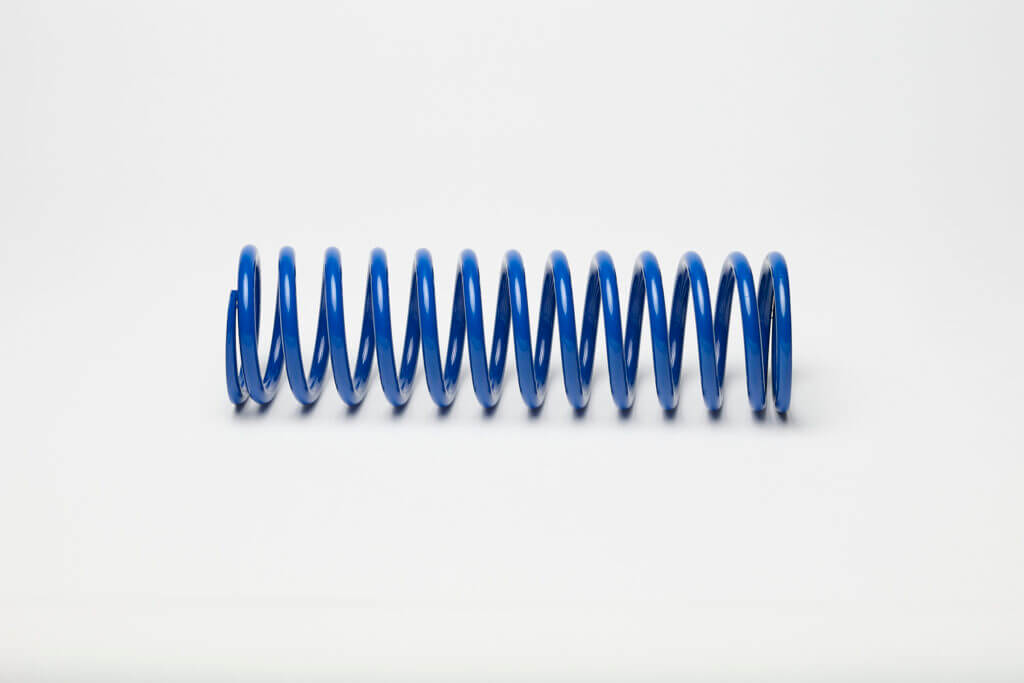
Diamond Wire Spring produces Compression, extension, torsion, die (rectangular wire) and wire forms in wire range of .008″ -.625″ wire sizes. We use most common materials such as carbon, alloy, non-ferrous, stainless, and high temperature steel wire.
A spring stores mechanical energy when compressed, stretched, or twisted, because the metal resists being deformed from its natural shape. The atoms in the material are displaced from their equilibrium positions, and the bonds between them generate a restoring force that pushes or pulls back. This restoring force is proportional to the displacement — a relationship known as Hooke’s Law (F = –kx) — meaning a stiffer spring requires more force for the same stretch. When the applied force is removed, the spring releases its stored energy and snaps back to its original form. If stretched beyond its elastic limit, however, the deformation becomes permanent and the spring loses its restoring ability.
*The environment in which the product operates
*The frequency of cycles and the amount of deflection
*The ratio of spring or wire form cost in relation to the overall project
*The expected life of the product
*Some springs are used in products that are discarded in a relatively short time frame and have a low cycle frequency during that time. In those cases, the design should specify a general-purpose spring wire, which can keep costs down while not affecting product performance.
Conversely, stainless steel is often specified in products frequently exposed to moisture. Other spring materials include Hastelloy C-276 alloy (for use in highly corrosive atmospheres), music wire (which is a carbon steel and has the best resilience to being deflected and distorted), chrome silicon, copper, aluminum, phosphorous bronze and so on.
Diamond Wire Spring has the capacity to manufacture springs from .008 inches to .625 inches in wire diameter. In some cases we can produce larger cold wound bar parts.
We manufacture springs for a variety of industries worldwide, including:
Agricultural
Energy and Power Generation
Medical Equipment
Oilfield Drilling and Mining
Pump and Valve
Railroad
Shock and Vibration
Snowplow and Trailer
…and many others!
We work with customers all the time, often making suggestions in an effort to improve their design and the fit or function of the part. We may also suggest modifying the design in order to facilitate assembly or reduce the cost of production.
Hot-wound springs are made from larger diameter material. Due to the size of the wire, the spring must be heated up to a hot state, then formed using an annealed (soft) material, and heat-treated afterwards. Cold-wound springs are smaller in size and are formed in a cold state using pre-tempered material.
Our complete sales terms and conditions can be found by clicking HERE